When an outdoor network cabinet sits exposed on a concrete pad in direct summer sun, ambient air temperature tells only half the story. Peak solar irradiance approaches 1,000 W/m² on flat horizontal roofs and west-facing walls. On an unshaded single-wall steel box, outer metal temperatures routinely climb to +65 °C to +75 °C (+149 °F to +167 °F) even when the local weather forecast reads +38 °C (+100 °F).
Inside a single-wall enclosure, that superheated steel panel conducts thermal energy straight inward and re-radiates infrared heat directly onto 19-inch switch chassis, power supplies, and optical transceivers. That is why every ONE OD-Series cabinet uses a three-barrier double-wall solar shield built to NEMA 250 / IEC 60529 IP55–IP65 outdoor thermal enclosure and EIA-310-E 19-inch mounting standards; thermal test sheets available per project.
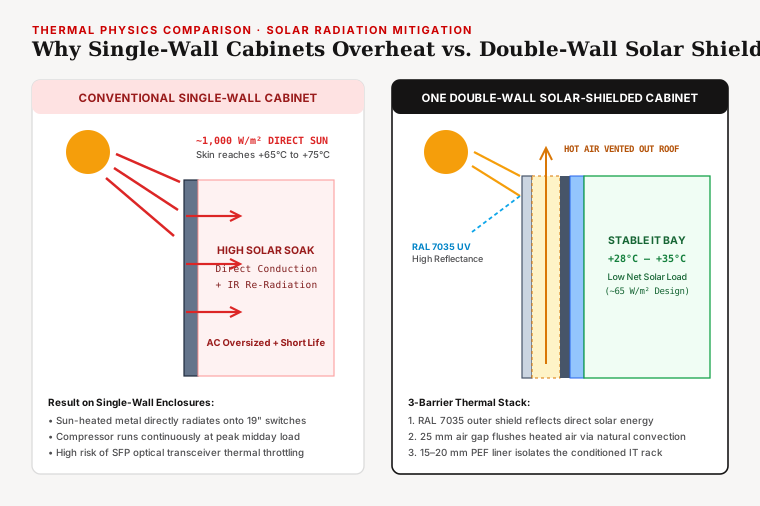
How the 3-Barrier Double-Wall Thermal Stack Cuts Solar Load
- UV-Stabilized RAL 7035 High-Reflectance Finish: Dark gray, green, or black street cabinets absorb 75–90% of incident solar radiation. Standard RAL 7035 light gray outdoor polyester powder coat reflects a substantial share of visible and near-infrared solar energy before it heats the metal skin.
- 25 mm Ventilated Thermosiphon Air Gap: An outer sacrificial solar panel stands 25 mm (1.0 in) proud of the sealed inner cabinet wall on all sun-exposed sides and the pitched roof. As sunlight heats the outer panel, warm air inside the cavity rises naturally and vents out through the roof canopy louvers—carrying heat away via passive chimney convection instead of conducting it inward.
- 15–20 mm Closed-Cell PEF Thermal Liner: Bonded to the interior face of the sealed inner steel wall, closed-cell polyethylene foam (PEF) slows residual conductive heat transfer when outdoor air reaches +50 °C to +55 °C, and prevents interior steel condensation during cold desert nights.
Single-Wall vs. Double-Wall Sizing Example (24U Pad Cabinet)
Consider a typical 24U WISP or roadside ITS cabinet (1400 × 750 × 750 mm, ~4.2 m² exposed surface area) running 380 W of active IT equipment in +45 °C summer ambient air with a +32 °C target internal temperature:
| Enclosure Shell Architecture | Internal IT Load | Est. Solar + Conductive Gain | Total Cooling Load Needed | Compressor Sizing Consequence |
|---|---|---|---|---|
| Single-Wall Uninsulated Steel | 380 W | ~620 W – 780 W | 1,000 W – 1,160 W (3,412 – 3,958 BTU/hr) | Forces step-up to 1200W–1500W AC + higher power draw |
| ONE Double-Wall + PEF Liner (OD-24U-AC600) | 380 W | ~270 W – 370 W | 650 W – 750 W (2,218 – 2,559 BTU/hr) | Dramatically lower peak load, smaller breaker, longer compressor life |
Note: Always include a 15–20% engineering margin when ambient peaks approach +50 °C; for continuous IT loads above 450 W in extreme desert sun, step up to the OD-32U-AC2000.

Orientation & Site Placement Best Practices
- Face the Door North (Northern Hemisphere) or South (Southern Hemisphere): Keep the door-mounted AC condenser intake shaded from peak late-afternoon western sun whenever pad geometry permits.
- Maintain 300 mm (12 in) Clearances: Keep vegetation, chain-link privacy slats, and concrete barriers at least 300 mm away from the AC condenser intake/exhaust louvers and double-wall perimeter vents so hot air does not recirculate.
- Keep Roof Overhang Unobstructed: Never mount large flat solar panels flush against the cabinet roof without standoff brackets that preserve thermosiphon roof venting.
Run Your Own Site Numbers
Model your exact cabinet surface area, IT wattage, and peak outdoor ambient temperature right now in our Outdoor Solar Heat Load Calculator, compare compressor voltage options in our 110V vs. 220V Enclosure AC Sizing Guide, or request a verified project thermal sheet via our 15-Minute Formal Quote Brief.
Standard & Custom-Engineered Models
12U Pole/Pad Mount + 300W Micro-AC
Compact 12U double-wall solar-shielded cabinet pairing a 300W (1,024 BTU/hr) closed-loop compressor AC with heavy-duty pole/wall/pad brackets for WISP relays and campus fiber nodes.
Full Datasheet →24U Double-Wall + 600W AC
Balanced 24U pad-mount double-wall cabinet combining a 600W (2,047 BTU/hr) closed-loop air conditioner with a segregated lower 48V battery bay for WISP distribution hubs and roadside ITS.
Full Datasheet →Flagship 32U Double-Wall + 2000W Industrial AC
Flagship 32U double-wall solar-shielded enclosure pairing a high-ambient 2000W (6,824 BTU/hr) closed-loop industrial AC with full-depth 19-inch rails for dense ITS, solar-BESS, and mining edge compute.
Full Datasheet →